Tuesday, February 19, 2013

Creating Authentic Behavior

Artistic Director Beth Harper discusses her approach to teaching Acting One in the first year of the conservatory's two-year professional training program.


How does one go about creating authentic behavior? Stanislavski believed that truth in acting is not the same as simply recreating everyday life. Truthful acting on stage must be compelling to an audience and, as such, is rarely the mundane behavior common in everyday life. The power, the urgency and the heightened "stakes" of a fictional character's circumstances must be realized, leading the actor to a compelling characterization. 
Beth Harper and Grace Mikolavich

Stanislavski was clear to point out that an actor's job is not to believe that he is, in fact, actually Hamlet. The actor, rather, must immerse himself in the imaginary circumstances he has created through his research, work on objectives, and employment of emotional and sense memory to create the "truth" of Hamlet for himself in the performance.

I believe that an actor must know him or herself. The truth is, an actor will never ever become another person. That is an impossibility. Often I hear actors say that they got lost in their character. What does that mean? For if you are lost...where are you? If I am acting with you, I need you in the room with me, I need you to need me. It is my hope that we get found in our characters and have the presence of mind to stay open to all the possibilities that are right in front of us. It will ultimately be the living, breathing actor taking on and making her own the behavior of another person. Where does one begin? I think we start with what we know best...ourselves.

Through the exploration of the NEED scene (a moment of high stakes in the own artist's life) actors soon discover that they organically experience the concepts of need, obstacle and tactic, and can more readily be available to apply it to “character.” However, character is just an idea unless you can apply it to moment-to-moment life. What does the character do or how do they behave in an imaginary set of circumstances?

By engaging their impulses, intelligence and imagination, the actor explores the specific physical and emotional life of a character. The artist must master the ability to be present in the moment and play their active actions to, for and with their fellow player, while simultaneously respecting the given circumstances of the world that they are playing in.

Thus, the basic building blocks of the acting process are:
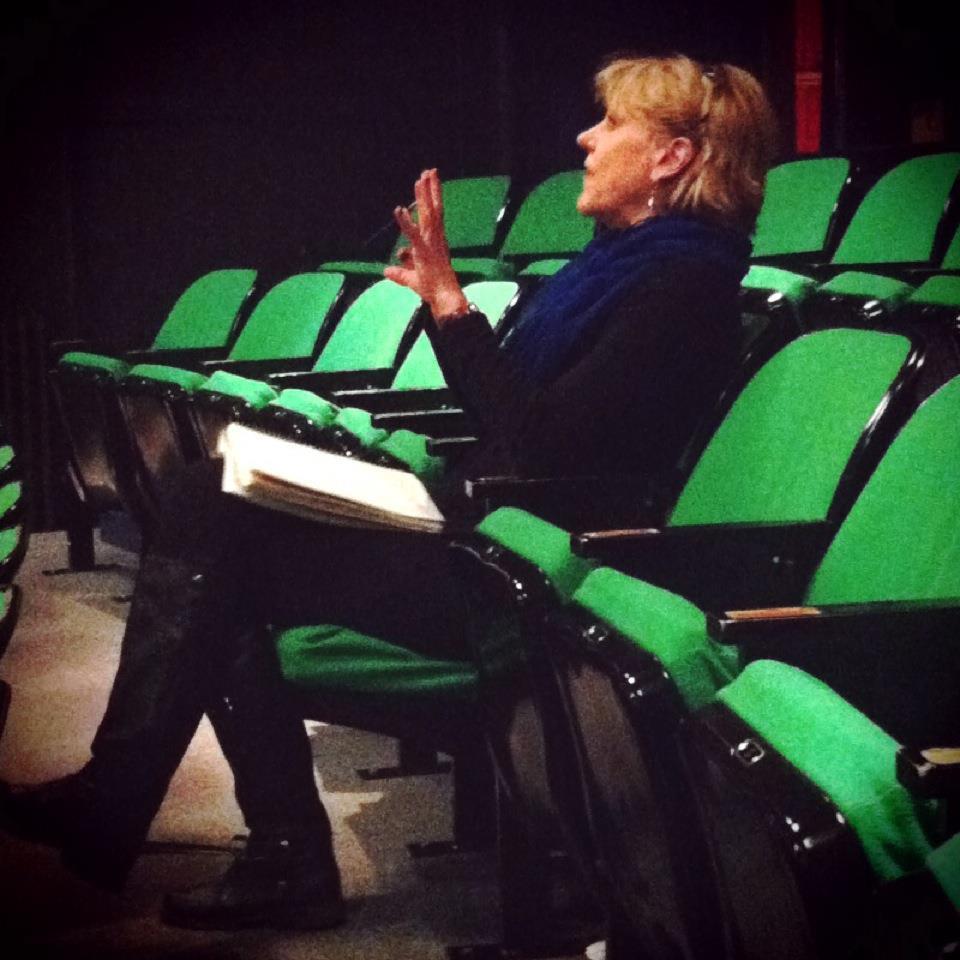

Beth Harper directs Holy Ghosts at PAC, 2012
  • the vocabulary and execution of objective, obstacle and tactic;
  • flexibility, imagination and sensory awareness;
  • being present in their own skin;
  • surrendering to a set of imaginary circumstances;
  • the ability to receive and adjust to another person's behavior;
  • and the skill set to execute a comprehensive beat analysis and most importantly be able to to translate their beat work into active and honest action and moment to moment life.
 
These are the skills an actor needs to create authentic behavior.

Monday, January 28, 2013

URTA NYC Auditions - If I Can Make it There...


Executive Director Philip Cuomo is in New York City for the University/Resident Theatre Association (URTA) auditions. Here are his thoughts from the first day:


Sitting in the lobby of the Times Square Hilton Hotel, I am surrounded by excited student actors, many of whom participated in the screening audition yesterday. They performed two contrasting monologues for two auditors. Later in the evening they were notified if they were accepted to participate in the final auditions.

The majority of them heard "No."

For most of those students this was their first major rejection. Many of them are used to the positive feedback they received in their undergraduate programs. They spent weeks choosing monologues and working with teachers to develop those pieces. They spent much of their student budgets traveling to New York City: paying for transportation, hotels and food. And now they are told they won’t make it to the final audition.

But it’s not over yet. They are lucky because three years ago URTA began an open call, in which the students not accepted for the final audition may participate.

Though instead of performing two contrasting monologues in a comfortable five minutes, they have 60 seconds to perform whatever material they desire. Forget the work done with their teachers back at school, forget the 2-minute comic monologue that kills, or the 2-minute dramatic monologue that they know would bring people to tears if they had one more chance to perform it. They march in one after the other in a brisk 110-120 seconds of steady introductions, identification of material and edited performance.

The open call is a difficult environment for aspiring and seasoned actors alike. The student actors wait in a large conference room, the nervous energy thick like smoke, and then they march into another large conference room, with terrible acoustics and auditors facing them from rows of folding chairs.

But these students are lucky – they have another chance. In the years before the open call, students not participating in the finals were sent home, not seen by any schools. I know the effects of this type of rejection, because I failed to be accepted into the final auditions three years in a row.

Yet I was successful making a life in the theatre. Like the successful young actors participating in this year’s open call, I hustled. I determinedly found the training and experience I needed and I persevered.

I am grateful to represent Portland Actors Conservatory at the URTA auditions in New York this winter. I have the chance to see many talented young actors express themselves. I will talk to several of them and educate them a bit about our conservatory program, and most importantly remind them they were seen by a successful theatre artist who recognized something specific in them.

I will be looking for the actor who states their name with confidence and charm, who commits fully to the circumstances of their text, who speaks their dialogue with conviction and simple clarity, who makes active choice, allowing energy to flow freely through their instrument and resonate among the rows of folding chairs. I am certain that today out of the hundred plus young actors that I will see, several of them will go on to have even more successful a life in the theatre than I am enjoying. I am glad to be a part of their journey.

Tuesday, November 13, 2012

Acting and Experimentation by Shelly Lipkin, director of A Bright Room Called Day on the PAC Stage Nov. 30 – Dec 16

I started out as a stage actor, and wanted nothing more than to hit the boards and stun the audience with my brilliance. The first full-length play I was cast in became a series of lucky experiments for me. Although the end result turned out well (as far as my memory serves me), I had no previous acting classes to support my work, and therefore the term "experiment" became my mode of learning. It's true that actors experiment with their work, but without a proper foundation in how to approach that experimentation, performing in a play can become more like shooting in the dark.

I would have to say that it has taken me the past 40 plus years to develop the paradoxical mix of of raw talent, critical analysis, absolute physical and mental control and complete emotional abandon that is the craft of acting, and it is what I try to impart as an acting instructor.


A Bright Room Called Day
Photo: Owen Carey

The Advance Acting I course I am currently teaching at Portland Actors Conservatory is designed to fully incorporate the lessons and skills of the students’ first year course work. Our process of rehearsing and performing a full-length play puts into practice the entire scope of an actor's core skills. The first production of this year, Tony Kushner’s A Bright Room Called Day, is a contemporary and realistic play, and therefore demands a naturalistic performance.

As director I stress the importance of making specific and active choices that will lead the actor to a more fully realised and multi-dimensional character. A full exploration of the character's backstory, given circumstances, objectives, obstacles and tactics steer the actor toward those goals.  Understanding the character's "why" will logically raise the emotional stakes in any given scene and heighten the conflict in the story - and telling the story is everyone's goal in play production.

Story can sometimes elude an actor who is involved in the minutiae of their character's development and specific scenework.  However, where and how a character fits into the overall storyline and theme of a play help the actor make choices that drive the action of the story. A director becomes the objective guide to that process, and an actor must understand the importance of the collaborative process during rehearsal. Therefore, each actor will develop a "beat analysis" which become a road map for the character’s emotional life and how that fits into the overall scope of the play.

Each actor will create a journal to help them understand how the creative process affected them, how they dealt with it, what worked and what didn't. The journal becomes a mirror for them to see how they work. 

The actual run of a play can be just as daunting as the rehearsal process. Sustaining a performance and growing within the restraints of the director’s and playwright's visions are important ingredients in the creative process. The actor must learn how to approach each night's performance as a clean slate, remembering the structure, while simultaneously staying free enough to react spontaneously to the "given circumstances" of that particular evening’s performance.

Although I later trained at a conservatory and worked in repertory theatre in dozens of plays, it is when I became a film actor I began to see that acting required a focus on truth and honesty, and that my best work came from reacting, rather than generating a "performance." It turned my head in the right direction and turned me into a better actor.  This simple truth is what I try to instill in all my students. It does not mean an actor ignores the other ingredients that make for an interesting, and sometimes brilliant performance.  Character development, back-story, script analysis, moment before, motivation, intention, active choices and need are all important ingredients in the creating a living, multi-dimensional character.  However, the one underlying bonding force that keeps an actor focused and in-the-moment, is, as I like to call it, the luxury of reacting as if it were the first time.

About Shelly Lipkin:
Shelly is an actor, director, playwright and acting instructor. He studied acting at College of Marin, United States International University - School of Performing Arts and holds a BA in Humanities from Linfield College. He performed with Berkeley Repertory Theatre, Santa Fe Repertory Theatre, PCPA in Santa Maria, and other theatres across the country. He spent 20 years in Los Angeles as a television and film actor, acting in sitcoms, films, episodic television, and commercials. During that time he helped found the West Coast Ensemble Theatre and won a Best Director Award for an original play Valentines and Killer Chili.  In 1998 he moved to Portland where he continues to act and teach. Recent film/TV credits include Extraordinary Measures,  Music Within, TNT's Leverage, Grimm, Portlandia, and the Sundance Award winning film Mean Creek. Shelly was Co-Artistic Director of Cygnet Productions from 2000 to 2003 where  he co-authored, produced and starred in Vitriol & Violets – Tales From The Algonquin Round Table which won the 2004 Oregon Book Award for Drama.  At Artists Repertory Theatre he performed in Blue/Orange, Gross Indecencies and The Clean House. Some of his favorite roles include Malvolio in Twelfth Night with Tygres Heart Shakespeare Company, and Ted in Collapse for Third Rail Repertory, which garnered him a Drammy Award. For Profile Theatre he performed in The Price, Sisters Rosensweig, and Thief River.

As a playwright, he received a RACC Grant, a Literary Arts Fellowship, and an Oregon Arts Commission Fellowship to develop his second play, Sylver Beaches, which recently had a staged reading in Paris, (yes, France), and was nominated for an Oregon Book Award. It is currently in development as a screenplay.  In the past he has taught at University of California, Berkeley, Cal Arts, Clark College, Marylhurst University, The Stella Adler Academy, Northwest Children's Theatre, Lakewood Theatre, and Young Musicians & Artists Camp. Currently he teaches acting, directing and screenwriting at The Art Institute of Portland, Portland Actors Conservatory, and privately.

Tuesday, October 23, 2012

2012-2013 Season a Reflection of the Times

PAC’s 2012-2013 season reflects the politically charged climate of this election year, and considers the power of the individual to effect change, in their own lives and in the world.

A Bright Room Called Day opens Nov 30
Photo credit: Owen Carey
Kicking off the season is a powerful drama from the author of Angels in America. Set in 1930’s Berlin, Tony Kushner’s A Bright Room Called Day will resonate with modern audiences as it explores themes of political action and inaction and the dilemmas inherent in recognizing and taking a stand against injustice and evil. Directed by PAC faculty member Shelly Lipkin, Bright Room opens November 30.

We are fortunate to have Third Rail Repertory Theatre's Artistic Director Scott Yarbrough on board to direct the second show of the season: Tom Stoppard’s Rosencrantz and Guildenstern are Dead. This acclaimed absurdist play, featuring physical comedy and Stoppard's sharp and witty use of language, is both a fun romp and an existential journey. Opens Feb. 8.

The final show, Eric Bogosian’s subUrbia, is directed by PAC Producing Artistic Director Beth Harper and centers on a group 20-somethings desperately seek meaning and direction in a mini-mall parking lot. subUrbia reflects the angst, inertia, and ultimately the anger felt by modern youth in suburban America. Opens Apr. 12.

Together the three shows will raise questions for our audience about looking beyond the limited view of our immediate circumstances to find a larger purpose and path in the world.

Resident creative team Tim Stapleton (scenic design), Jeff Forbes (lighting design), Chris Mikolavich (sound design) and Jessica Bobillot (costume design) will bring creative insight, cohesion and unification to the overall production values of the season.

Included in each subscription are tickets to the annual Graduate Showcase, where graduating Second Year students present scenes and monologues representing the culmination of their study at the Conservatory. The Showcase runs May 15-18, 2013.

Subscription prices for the 2012-13 Season of Plays range from $20-$80, and are available online at www.actorsconservatory.com or by calling (503) 274-1717.

Thursday, September 27, 2012


Summer is over.

It’s the first day of Movement Class.

by Philip Cuomo

This is a big day. First year students are especially amped as this is the first class of the year and their first class ever at PAC. Their excitement is palpable. Little do they know I will soon make them stand in place still for an uncomfortably long time.

Before we start we identify the four movement descriptors defined by Rudolph Laban as space, weight, time and flow. They are similar to Mary Overlie’s Six Viewpoints and the nine Viewpoints Anne Bogart expanded them into. Space, weight, time and flow are incorporated into the Viewpoints and I use the word descriptor to simplify the concept and not to confuse the students. They are a given vocabulary from which to talk about how the body moves, as the Veiwpoints are ways to talk about physical action in space. Both amazing complements to the way in which Stanislavksi defines physical action in psychological terms.

But I am super excited to make the students stand still in movement class. I love the irony.

We start with a subtle energy exercise of rolling up and down the spine. I learned this from Kristan Linklater’s work in voice class. It is an exercise repeated infinitely by many teachers and executed by my students until they are sick of it.

Of course we also do several aggressive energy exercises in and around stillness. Heart-pumping sweat-inducing exercises based on the work of Jacques Lecoq. I call one of my favorites the sway. Seemingly natural, yet surprisingly calculated students begin to move very specifically from their hips side to side.

The other exercise I call the Effort Flower. Lecoq referred to  it as the Effort Rose but I have slammed and squished it and when I watch the move I see a daisy so I renamed it. The movement starts in the actor’s core and flows out the arms. If you were to draw semis circles around the extended hands you would see flower petals. The core of the actor’s body is the pistol, or is it stamen? When I do the movement it is a pistol: when my teaching assistant Sascha does it is a stamen. Of course, if you were French you might see a rose, but I see a daisy. Hence the change of name from Effort Rose to Effort Flower. The audience determines the specific reference.

The audience is inspired by the actors work: a great first lesson for the students on their first day.

Tuesday, August 14, 2012

Part 3: Bridging the Gap: Educational Theatre to Professional Theatre

Emerging as a Professional
by Philip Cuomo
 
The following is the final post of a 3-part series about how an emerging theatre artist moves beyond their training into the professional world. This was inspired by a conversation I facilitated with a group of artists at Post5 Theatre as part of the first annual Outdoor Shakespeare Festival.

I finished my conservatory style theatre training in the 1980’s and with a few compatriots immediately formed a company: Oberon Theatre Ensemble. I spent three seasons working with Oberon and as a group we recognized that we were not developing as quickly as we wanted. I realize now that I was an impatient young man. But in looking for ways to improve, our company members branched out.

I met and worked with Robert Mooney, a teacher at ACT in San Francisco and a working theatre artist. I saw him perform Sir Toby Belch in New York City, one of many Sir Toby’s I have seen, and Robert was wonderful. His skill allowed him to be funny, mean and sympathetic all at once.

I enrolled in an audition workshop at the RiversideShakespeare Academy in New York that Robert taught. He created a list of ten possible audition pieces for me (that alone was worth the price of the class!). But the best bit of advice, or practice, he asked of the class - of me - was to identify people in the field I admire and want to work with. He challenged us to find ways to meet them, audition for them and eventually work with them. He made us create a list of 20. 

Mark Lamos
My list included Mark Lamos, who was the Artistic Director at Hartford Stage in Connecticut. Shortly after putting him on my list I met him on a shoot of the film Longtime Companion. Mark was playing a lead in the film and I had a chance to be an extra for a day of shooting. I took the opportunity not for the $50 I was getting paid, not for the outside possibility that I would be upgraded to an under five, or for any other reason but to have the chance to meet Mark.

I introduced myself. He barely looked me in the eye as he shook my hand and moved away. The moment passed very quickly.

A year later I auditioned for him at Hartford Stage. They had an open call for a production of Romeo and Juliet and they needed Italian looking people. When I told him of our introduction he pretended to remember, and then he cast me as a supplemental extra. I was to be a background player. 

It was an artist-defining production for me. I was surrounded by some of the best and most accomplished American theatre artists: Roberta Maxwell, Robert Stattel (who introduced me to Julie Taymor and helped me land an audition for her), Bill Camp, Calista Flockhart (before Ally McBeal) Chuck Conwell…the list was long. 

Chuck was the fight choreographer and one of the reasons I was cast was for my physical ability and how well I moved. I was looking forward to the first fight call and getting a sword in my hand. But Chuck did not give me one.  

Charles Conwell teaches broadsword for
Philadelphia Stage Combat Workshop
I told him, “But, hey, I am good at this stuff!” 

He patted me on the back and said “Yeah, not everyone gets to carry a sword.” 

Instead Chuck gave me a three-foot length of sausage. I was the sausage man. Chuck then choreographed a sprawling fight with 16 combatants. And as the sausage man, I beat the crap out of the three largest swordsmen with my three foot length of sausage. 

I developed a simple and funny walk. During staging rehearsals I found opportunities to play around: slipping into a fountain, teasing the washer wenches, and getting tangled up in laundry. Then whenever Mark needed an added interesting dynamic to a scene or location he would call for the clown. “Get the clown out here,” he would say.

Before I knew it I was a clown. Bart Sher, who was the assistant director on the production, passed an essay from American Theatre to me about the commedia, other members of the artistic community suggested books to read and actors to watch. When I returned to New York I met and studied with David Shiner. I had seen David on Broadway in his Tony award-winning clown show with Bill Irwin called Fool Moon. David had made a name for himself in Cirque du Soleil. In fact he directed and created the last Cirque show here in Portland, KOOZA. After working with and learning from David for a couple of months, I never stopped working in the theatre again.

I was mentored by some of the best theatre artists in the country and they provided a path unique to my talents which helped define my artistry, my career or, as Sydney said some twenty plus years ago, my "lifestyle."


Tuesday, August 7, 2012

Part 2: Bridging the Gap: Educational Theatre to Professional Theatre


Collaboration and Community
by Philip Cuomo


The following is the second in a 3-part series about how an emerging theatre artist moves beyond their training into the professional world. This was inspired by a conversation I facilitated with a group of artists at Post5 Theatre as part of the first annual Outdoor Shakespeare Festival.

Growth as a theatre artist is especially challenging because it is so collaborative. One cannot quietly practice in a well-lit private studio, as a visual artist might, or a comfortable soundproof basement, as a musician might. The creation of theatre art is communal. It requires a community.

Both our educational and our professional institutions provide the infrastructure and community necessary to create theatre. Schools bring together people of like minds and interests, providing them with guidance, assignments and projects. Professional theatres bring together artists of comparable skill levels to collaborate on productions. Both form communities from which theatre is created.

The emerging artist needs to be challenged within their practice. It starts with training.

The Neighborhood Playhouse, NYC.
Professional training programs like Portland Actors Conservatory, ACT in San Francisco, The Neighborhood Playhouse in New York offer comprehensive immersion training for a community of like minded students. Professional theatres like Portland Center Stage bring together artists from around the nation. They are part of the American Theatre community.

The issue before us is how does an emerging actor develop the skills necessary to be part of the professional community of theatre artists both locally and nationally?


PAC alum Maureen Porter (far left) joins professional actors from
across the country in Anna Karenina at Portland Center Stage.
Photo: Patrick Weishampel
Immersion in an integrated curriculum establishes the basis for continual development. Training in a traditional academic setting or occasional classes does not provide a comprehensive understanding of the actor’s craft. Immersion in a program which includes enough hours exercising the voice, body and imagination creates the internal environment for an emerging actor to execute authentic action within imagined circumstances. There is a simplicity to the craft that is not easy and only through time does the emerging actor’s instrument fully understand and integrate the craft. Immersion training offers the actor the opportunity to practice and replicate the experience.

Once an actor recognizes the experience of spontaneously communicating authentic action and is able to consistently execute authentic action, they simply need to apply their craft in practice. I believe when emerging theatre artists put themselves in challenging roles in challenging plays, with talented directors who challenge them further, their skill set will develop within their practice. If an emerging actor does not learn the craft necessary to replicate authentic action it will take longer for their talent to develop. In this case, then, the gap between educational and professional theatre becomes wider.

So what is the venue for the well-trained theatre artist to develop the skills necessary to be part of the professional theatre community? The artists at Post5 have created a performance platform from which they are able to challenge themselves with difficult text in front of audiences. This is a great start. Post5 has also made a commitment to bring established professionals to either direct or act in productions, exposing their core company to wider influence.

Is that enough? Does the emerging theatre company provide the proper environment for developing skills?